Bridging Space Technology and Spatial Planning to Unlock New Opportunities
Digital Task Force for Planning and Space4Climate bring together innovators to unlock collaboration and build more resilient places.
Bridging Space Technology and Spatial Planning to Unlock New Opportunities
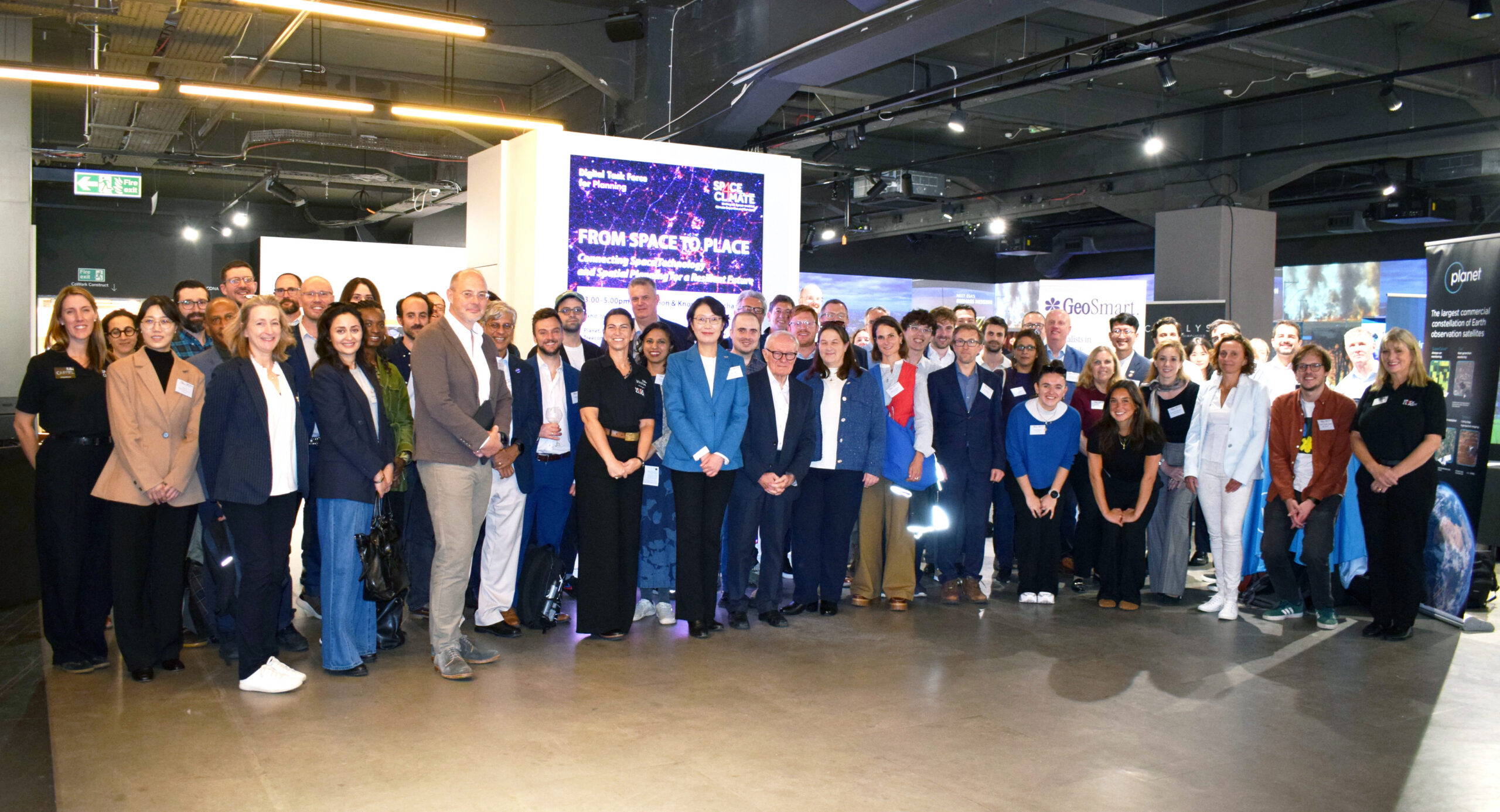
On 13 October 2026, the Digital Task Force for Planning (DTFP) and Space4Climate welcomed over 120 delegates from more than 80 organisations to From Space to Place, held at The Building Centre in London.
The event marked the first joint activity under the new partnership between DTFP and Space4Climate, following the signing of a Memorandum of Understanding in September 2026.
Bringing together innovators, researchers, policymakers and practitioners, the event explored how Earth Observation (EO), geospatial intelligence and digital planning technologies can support more integrated, proactive and resilient place-based decision-making.
Connecting two sectors to unlock innovation
Dr Wei Yang OBE, CEO of the Digital Task Force for Planning, emphasised the importance of cross-sector collaboration:
“I have long believed that some of the greatest opportunities for innovation come from bringing different sectors together, where one plus one can be greater than two.
Tackling the grand challenges of climate change and biodiversity decline, and finding practical solutions for more resilient places, are shared responsibilities. Both the space technology and spatial planning communities have a significant role to play.
Space technology provides extraordinary capabilities to observe and understand our planet. Spatial planning translates that knowledge into decisions that shape our places. Together, these capabilities can enable more integrated, proactive and adaptive place-based decision-making, helping us build a more resilient future.”
Beth Greenaway, Chair of Space4Climate and Head of EO Delivery at the UK Space Agency, highlighted the growing opportunities for planning professionals to benefit from space-based intelligence:
“Space is very much part of our everyday world, we have 700-plus companies in the UK today using satellite Earth Observation data and in the recently-published UK Space Strategy the Government is investing £900m in the civil side of Earth Observation.
You can rely on these data and services. Now really is the time for users to get involved – the value of Earth Observation is as much as your imagination can unlock.”
The new partnership aims to bridge the gap between the growing availability of high-quality Earth Observation data and its practical application in spatial planning.
Showcasing innovation across 20 organisations
The event featured an interactive exhibition bringing together ten Digital Planning Directory-listed companies:
Esri | Cross Works | City Science | Prior + Partners | AtkinsRéalis | Space Syntax | PLACE LOGIC | PlanningHub | Digital Urban | VU.CITY
Alongside ten Space4Climate members:
Planet | NetZero Protocol | GenTian | 4EI | MapImpact | GeoSmart | Treeconomy | EO DataHub | Catalyst | Environment Systems
Each exhibitor delivered an introduction, followed by hands-on demonstrations and networking. The lively format encouraged knowledge exchange and new connections between the two sectors.
Expert perspectives on resilience and investment
The event also featured contributions from Professor Michael Batty CBE, Chair of DTFP and Chairman, Centre for Advanced Spatial Analysis (CASA), University College London, who explored the relationship between spatial planning innovation, climate change and resilience.
Mike Zehetmayr, Chair of the UK Carbon Markets Forum, highlighted the potential of Earth Observation data to support natural asset valuation, carbon markets and sustainable investment. He emphasised that environmental intelligence must be translated into credible evidence that can inform practical decisions and mobilise investment.
Together, the discussions demonstrated how combining space-based intelligence with digital planning tools and local knowledge could strengthen decision-making on infrastructure, nature recovery, climate adaptation and sustainable development.
Turning innovation into practical collaboration
The event provided a starting point for closer collaboration between the two sectors, opening new opportunities for Digital Planning Directory companies to connect their expertise with emerging space technologies.
Reflecting on the event’s success, Dr Yang concluded:
“This is just the beginning. We look forward to building bridges between the two sectors and turning new ideas into practical collaborations.
Ultimately, the real value of space technology is not simply what we can see from above, but what we can do differently on the ground.”
DTFP extends its thanks to the Space4Climate team, particularly Donna Lyndsay, Sally Stevens and Carmel Harmston, The Building Centre team, and all speakers, exhibitors and delegates who contributed to the event.


