Objective
Advancing Evidence-Led Site Assessment at Northumberland County Council
Advancing Evidence-Led Site Assessment at Northumberland County Council

Details:
- Company: Objective
- Client: Northumberland County Council
- Year: 2025 - 2026
- Region: England
- Product: Objective Keyplan
Service areas:
- Community engagement
- Geographical information systems (GIS) and mapping
- Land search and assessment
Introduction
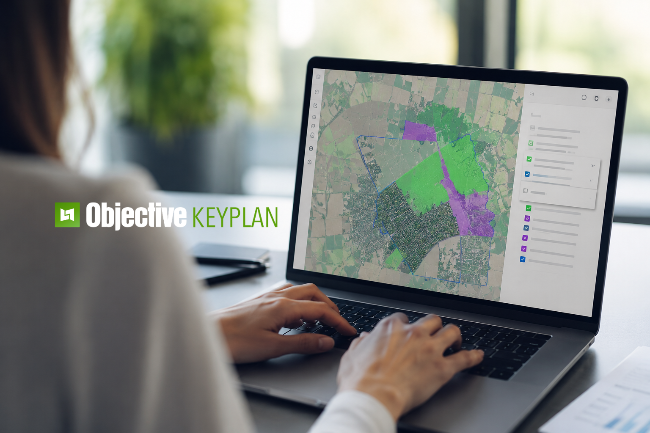
Discover how Northumberland County Council modernised its site assessment and Call for Sites process using Keyplan and Esri integration to improve efficiency, data quality and collaboration across planning and GIS teams. By implementing a digital, map-led approach, the council streamlined submissions, reduced manual administration and improved evidence-based decision-making. Over 90% of site submissions required no further officer interaction, significantly reducing processing time and improving consistency. A dedicated video case study will be published next month, but in the meantime you can explore the project further by watching the webinar and hearing directly from the team behind the transformation.
Challenges
* Managing large volumes of site assessment data
* Coordinating information across multiple teams and departments
* Reliance on disconnected or manual workflows
* Difficulty maintaining a transparent and consistent assessment process
* Limited ability to visualise spatial planning data effectively
* Time-consuming data management and assessment activities
* Improving accessibility and usability for officers and stakeholders
* Supporting evidence-based decision-making more efficiently
* Creating a scalable process suitable for future planning requirements
* Modernising legacy approaches to improve collaboration and efficiency
* Coordinating information across multiple teams and departments
* Reliance on disconnected or manual workflows
* Difficulty maintaining a transparent and consistent assessment process
* Limited ability to visualise spatial planning data effectively
* Time-consuming data management and assessment activities
* Improving accessibility and usability for officers and stakeholders
* Supporting evidence-based decision-making more efficiently
* Creating a scalable process suitable for future planning requirements
* Modernising legacy approaches to improve collaboration and efficiency
Solutions
* Integrating Esri with Keyplan to create a connected and efficient flow of planning data
* Implementing a centralised digital platform for site assessment management
* Bringing together spatial planning data into a single accessible system
* Enabling interactive, map-led site assessment using geospatial technology
* Streamlining planning workflows through improved digital processes
* Improving collaboration between planning officers, departments and stakeholders
* Supporting evidence-based decision-making with real-time planning data
* Enhancing accessibility and usability for planning teams and consultees
* Reducing reliance on manual processes and disconnected legacy systems
* Creating a scalable digital planning solution to support future Local Plan requirements
* Delivering a more transparent and consistent approach to site assessment
* Modernising the council’s planning and site assessment infrastructure
* Implementing a centralised digital platform for site assessment management
* Bringing together spatial planning data into a single accessible system
* Enabling interactive, map-led site assessment using geospatial technology
* Streamlining planning workflows through improved digital processes
* Improving collaboration between planning officers, departments and stakeholders
* Supporting evidence-based decision-making with real-time planning data
* Enhancing accessibility and usability for planning teams and consultees
* Reducing reliance on manual processes and disconnected legacy systems
* Creating a scalable digital planning solution to support future Local Plan requirements
* Delivering a more transparent and consistent approach to site assessment
* Modernising the council’s planning and site assessment infrastructure
Results
* Over 90% of site submissions required no further officer interaction
* Improved the quality and consistency of site submissions through a digital, map-led process
* Reduced administrative burden associated with validating and managing submissions
* Enabled planning officers to assess sites faster using integrated GIS data
* Eliminated the need to manually transfer information between systems
* Created a single source of truth for site assessment data across planning and GIS teams
* Improved collaboration between planning officers and GIS specialists through connected workflows
* Increased confidence in site assessment recommendations through improved spatial evidence
* Enhanced transparency and auditability throughout the site assessment process
* Reduced time required to prepare, manage and review Call for Sites submissions
* Established a scalable digital framework for future Local Plan evidence gathering
* Future-proofed the council’s site assessment process through the integration of Keyplan and Esri
Watch the webinar here: https://www.objective.co.uk/resources/modernising-site-assessment-at-northumberland-county-council
* Improved the quality and consistency of site submissions through a digital, map-led process
* Reduced administrative burden associated with validating and managing submissions
* Enabled planning officers to assess sites faster using integrated GIS data
* Eliminated the need to manually transfer information between systems
* Created a single source of truth for site assessment data across planning and GIS teams
* Improved collaboration between planning officers and GIS specialists through connected workflows
* Increased confidence in site assessment recommendations through improved spatial evidence
* Enhanced transparency and auditability throughout the site assessment process
* Reduced time required to prepare, manage and review Call for Sites submissions
* Established a scalable digital framework for future Local Plan evidence gathering
* Future-proofed the council’s site assessment process through the integration of Keyplan and Esri
Watch the webinar here: https://www.objective.co.uk/resources/modernising-site-assessment-at-northumberland-county-council
“We’ve now got everything in one place [Keyplan] - all of the site assessment information rather than dealing with it from lots of different sources of data, again that saved masses of officer time.”
“It's that one-stop shop for everything”
David Hall
Planning Policy Officer - Northumberland County Council

