Cross Works
New Tashkent: masterplanning and a digital twin for a 25,000-hectare new city
New Tashkent: masterplanning and a digital twin for a 25,000-hectare new city

Details:
- Company: Cross Works
- Client: Directorate of New Tashkent (Government of Uzbekistan)
- Year: 2023
- Region: Global
- Product: New Tashkent Digital Twin
Service areas:
- Geographical information systems (GIS) and mapping
- Planning and urban design services
- Digital twins
Introduction
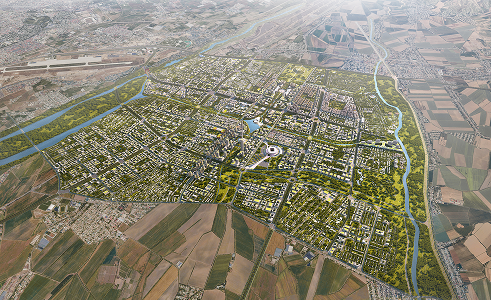
Cross Works won an international competition to lead the masterplan for New Tashkent, a 25,000-hectare new capital for Uzbekistan, doubling the existing city east of the Chirchiq River. Designed for 2.5 million additional residents and a Greater Tashkent of over 5 million, Cross Works, as lead design and technology consultant, set the vision, concept masterplan and urban design framework for the site, and produced the detailed masterplan for District 1 (6,000 hectares). The team built a digital twin in one web portal, showing how a new city can be planned around a live, data-driven model from sketch to site delivery.
Challenges
Expanding a capital by 25,000 hectares and doubling the capacity of Tashkent is an enormous undertaking. The masterplan had to accommodate up to 2.5 million additional residents without repeating the car-dependent sprawl seen in many fast-growing cities around the world, whilst also protecting the site’s valuable green space and water network. It also had to give a brand-new city a coherent identity rather than a patchwork of disconnected developments. A project of this scale involves many sub-consultants landscape designers, engineers, economists, real-estate advisers and more, and a government client that must review, approve and deliver in phases over many years. Keeping everyone working from a single, current “source of truth”, and communicating complex spatial decisions clearly to decision-makers and the public, was as much a challenge as the design itself.
Solutions
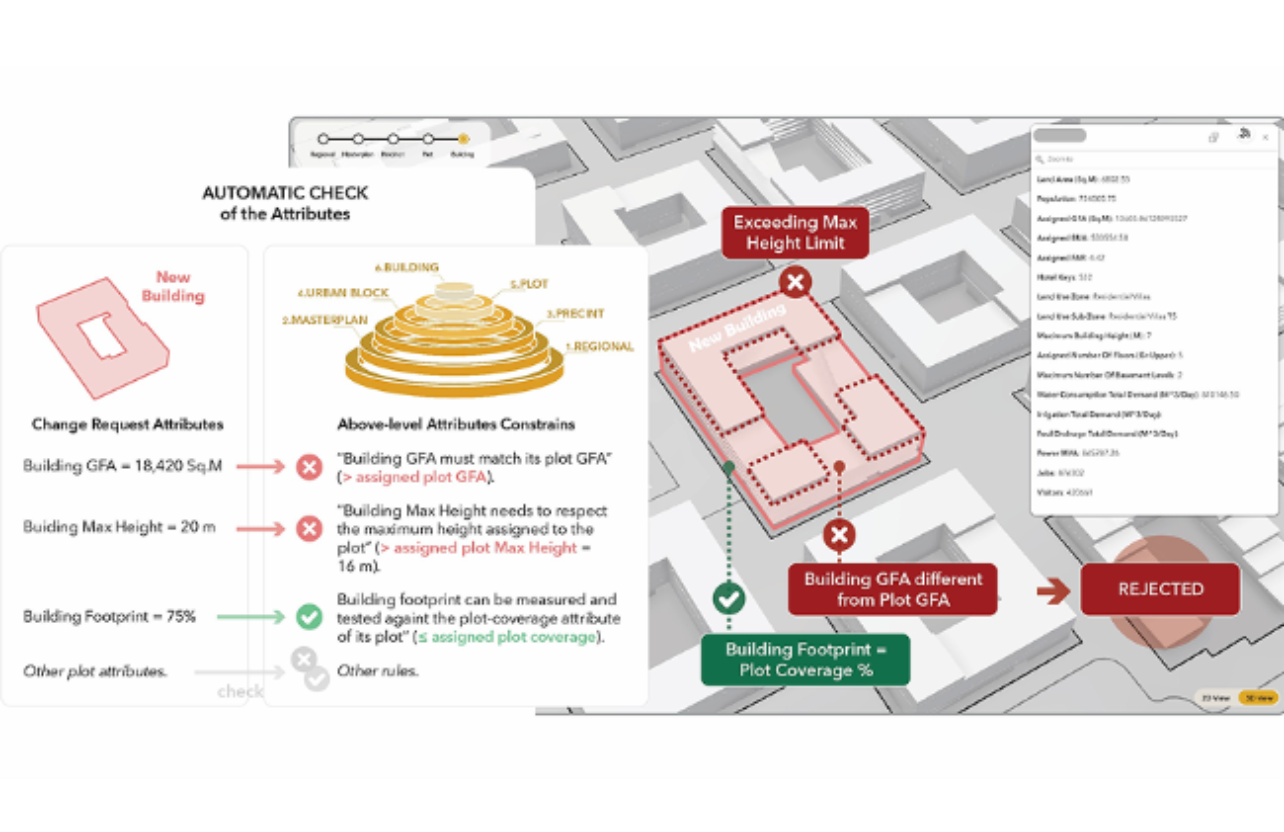
Cross Works established the masterplanning and urban design framework around “15-minute city” principles, so every resident can reach schools, clinics, shops and green space within a short walk or cycle. Around a fifth of the land is given to parks, supported by a network of canals. As a digital “container” for the masterplan , Cross Works developed an in-house digital twin: a single online platform combining 2D and 3D modelling, real-time GIS data, VR walkthroughs and layered design guidelines. Rather than static masterplan drawings, the Digital Twin acts as a living hub for the whole project, used to test design options, coordinate sub-consultants, present proposals to government, and govern how individual plots are assessed against the design code.
Results
In December 2024 the Uzbek government granted planning permission for the masterplan, with the detailed plan for District 1 — roughly 6,000 hectares approved as the first phase. The project has the backing of the country’s leadership and is now moving into delivery, with our design guidelines acting as the planning framework the Directorate of New Tashkent uses to assess development proposals. The digital twin remains the central reference for the scheme as it grows. The work has been widely featured across the international architecture and planning press and demonstrates a repeatable model: planning a city around a live, data-driven twin that keeps design intent, data and delivery aligned over the long term.