
Details:
- Company: Space Syntax
- Client: Space Syntax
- Year: 2020
- Region: UK-wide
Service areas:
- Planning and urban design services
- Plan-making, planning application and data management systems
- Digital twins
Introduction
The Walkability Index is a tool that allows existing places to be benchmarked and new proposals to be objectively tested in terms of whether they deliver car dependence, with its associated problems – or walkability, with the social, economic and environmental benefits found in walkable places.
Challenges
The location of everyday land uses – shops, offices, schools and healthcare facilities – has important effects on our movement choices: whether we reach them by walking or cycling, catching a bus or going by private car.
Sometimes there is no choice: low density, monofunctional housing estates create car dependence. This is not only harmful for the environment but damaging to our mental and physical health. Car dependence influences obesity and loneliness. In contrast, walkable places are healthy and sociable places.
Sometimes there is no choice: low density, monofunctional housing estates create car dependence. This is not only harmful for the environment but damaging to our mental and physical health. Car dependence influences obesity and loneliness. In contrast, walkable places are healthy and sociable places.
Solutions
Computer modelling is used to map everyday, non-residential uses and then measure how far they are from people’s homes. This is particularly influenced by the connectivity of the street network and the size of urban blocks. Is a route simple and direct or is it labyrinthine? Are there lanes and cut-throughs that make it easier to walk from A to B? Research shows that block sizes are typically smaller in thriving urban centres and larger towards the edges. This means there is greater ‘permeability’ around the shops and markets at the heart of settlements – where more people are – and less around the residential edges: a ‘natural’ relationship that ensures that all routes are continuously animated by human life, with a buzz towards the commercial centre and gentler levels of animation towards the edges.
Results
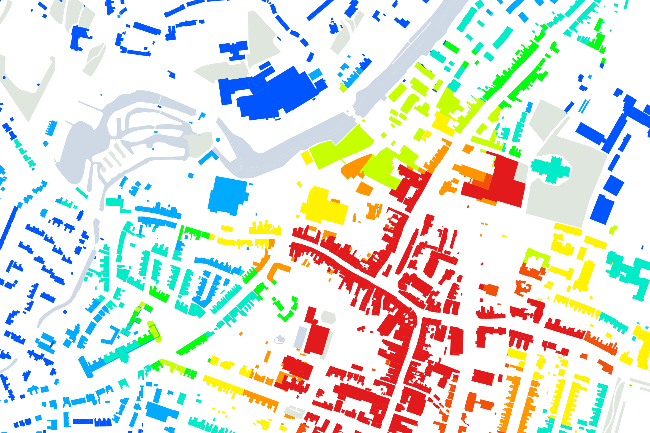
The Walkability Index heat maps describe the degree to which newer settlements have succeeded, or not, in emulating the lessons of historical places such as Clifton. By analysing each building in turn, it is possible to identify how many different everyday land uses are within a 5-minute walk. Poundbury scores highly, South Dorchester and Bradley Stoke less so.
Space Syntax’s Walkability Index database covers every building in Great Britain. It allows existing places to be ‘footprinted’ so that new proposals can be objectively tested in terms of whether they deliver car dependence – with its associated problems – or walkability – with the social, economic and environmental values that walkable places create.
Space Syntax’s Walkability Index database covers every building in Great Britain. It allows existing places to be ‘footprinted’ so that new proposals can be objectively tested in terms of whether they deliver car dependence – with its associated problems – or walkability – with the social, economic and environmental values that walkable places create.